It sounds like science fiction: an airplane that’s too heavy to safely take off, purely because of the outside temperature, with not a single extra passenger or bag added. But it’s real physics, and during the extreme heat waves of 2026, it grounded and delayed real flights at major U.S. airports. Here’s exactly why heat affects whether a plane can fly, and what it means if you’re traveling during one.
Table of Contents
- The Physics: Why Hot Air Grounds Planes
- Real Example: The 2026 Southwest Heat Wave
- The Hidden Risk: Heat on the Tarmac
- Your Rights During a Heat-Related Delay
- How to Protect Your Trip During a Heat Wave
- Frequently Asked Questions
The Physics: Why Hot Air Grounds Planes
Hot air is less dense than cool air. Since an aircraft’s wings generate lift by moving through air, and its engines generate thrust by compressing air, thinner hot air means less lift and less thrust for the exact same physical effort. At high enough temperatures — especially combined with high-altitude airports where the air is already thinner — a fully loaded aircraft may not be able to generate enough lift to take off safely within the available runway length.
Airlines address this through weight restrictions: rather than risk an unsafe takeoff, they reduce the aircraft’s total weight by bumping passengers, holding cargo and checked baggage, or reducing fuel load (requiring a refueling stop). This is a deliberate, conservative safety measure, not a malfunction or an overreaction.
Real Example: The 2026 Southwest Heat Wave
During the severe summer 2026 heat wave across the U.S. Southwest, temperatures exceeding 115°F across Arizona, Nevada, California, and Texas forced American Airlines and Southwest Airlines to implement takeoff weight-restriction protocols, leading to cancellations, passenger bumping, and baggage holds at several major hubs.
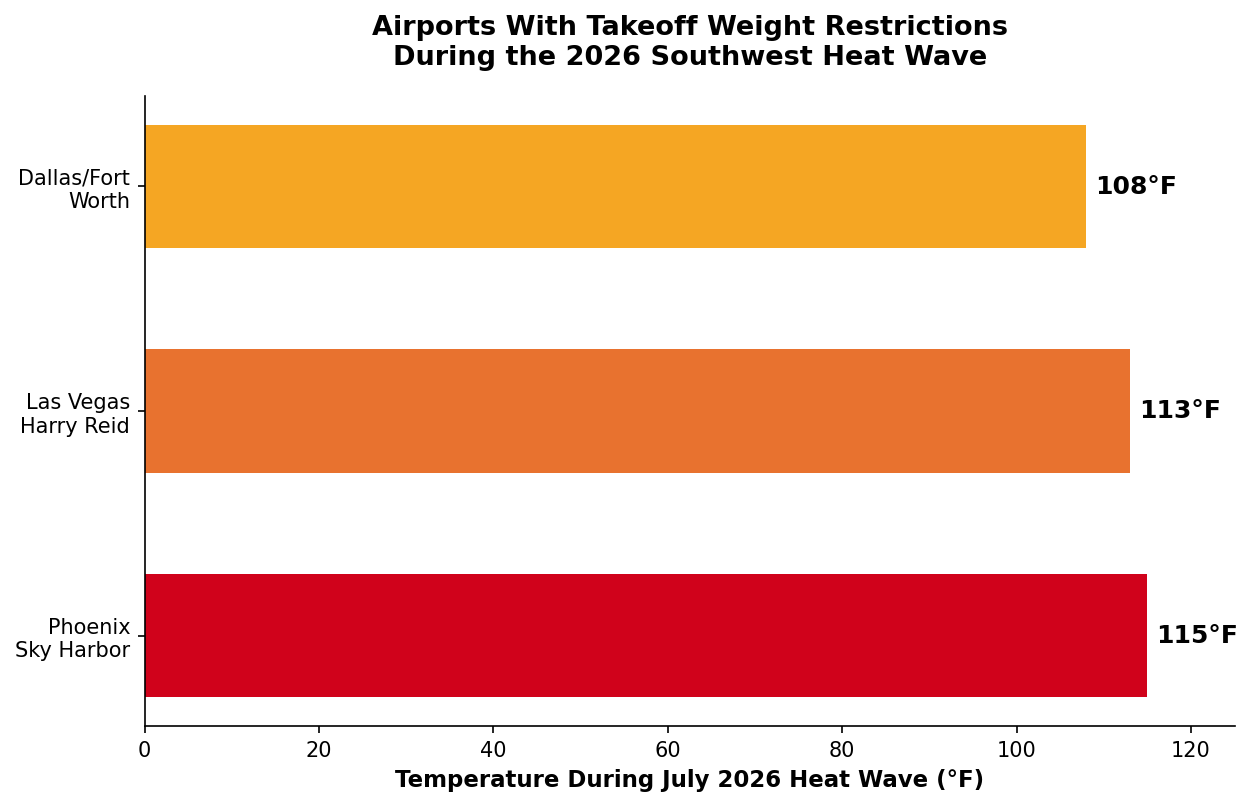
This is a phenomenon known as a “density altitude” limitation — the combination of high elevation and high temperature effectively makes the airport “feel” much higher in altitude to an aircraft’s engines and wings than its actual elevation, which is why hot, high-altitude desert airports face this issue more severely than sea-level airports even at similar air temperatures.
The Hidden Risk: Heat on the Tarmac
Beyond takeoff physics, extreme heat creates a separate, more immediate passenger comfort and safety issue: conditions inside a grounded aircraft. When a plane is actively flying or taxiing, its air conditioning draws power from the running engines. But when it’s sitting still on the tarmac during a lengthy delay, it often relies on a weaker auxiliary power system that may struggle to keep the cabin cool, especially with additional heat radiating up from the hot tarmac surface itself.
This matters because federal regulations require airlines to maintain comfortable cabin temperatures during tarmac delays, provide medical assistance if needed, and give passengers the opportunity to deplane during sufficiently long delays.
Your Rights During a Heat-Related Delay
- Extended tarmac delay protections apply regardless of cause, including heat. U.S. Department of Transportation rules generally require airlines to allow deplaning opportunities and maintain safe, reasonably comfortable cabin conditions during lengthy tarmac holds.
- Airlines have been fined for tarmac delay violations — a real example includes a major regional carrier fined $900,000 by the DOT for violating tarmac delay rules, underscoring that these aren’t just guidelines.
- Compensation for weather-related cancellations is generally not guaranteed the way it might be for a delay caused by the airline itself (like a mechanical or staffing issue), since extreme weather is typically classified as outside the airline’s control — though policies vary by airline, so check your specific carrier’s contract of carriage.
- Some airlines proactively waive change fees ahead of known heat events — during the 2026 event, for example, one major carrier waived change fees for affected routes through severely impacted airports.
How to Protect Your Trip During a Heat Wave
- Check your flight status before leaving for the airport, not just at your scheduled departure time — heat-related delays often develop later in the day as temperatures peak
- Book earlier flights when possible, since density altitude issues intensify as temperatures rise through the afternoon
- Carry water through security for potential tarmac waits or terminal delays
- Check for airline fee waivers if you’re flying through a severely affected airport — carriers sometimes offer free rebooking ahead of a known heat event
- Check your destination’s conditions too, not just your departure airport, with our Heat Index Calculator, since extreme heat at either end can affect your trip
Frequently Asked Questions
Can a flight really be canceled just because it’s too hot?
Yes. Extreme heat reduces air density, which reduces the lift and thrust an aircraft can generate. At high enough temperatures, especially at high-altitude airports, this can force weight restrictions, passenger bumping, or outright cancellations for safety.
How hot does it have to be to affect flights?
It depends heavily on the specific aircraft type and the airport’s elevation, since high-altitude airports face restrictions at lower air temperatures than sea-level airports. Temperatures exceeding 115°F triggered real restrictions at desert airports during the 2026 heat wave.
Am I entitled to compensation if my flight is delayed for heat?
Generally, weather-related delays and cancellations, including heat, are treated as outside the airline’s control, meaning guaranteed cash compensation is less likely than for airline-caused delays. However, tarmac delay protections around cabin comfort and deplaning still apply regardless of cause.
Why does my plane feel so hot while we’re waiting on the tarmac?
Aircraft air conditioning primarily draws power from running engines. During a stationary tarmac delay, planes often rely on a weaker auxiliary power system that can struggle to cool the cabin adequately, especially with additional heat radiating from the tarmac itself.
Which airports are most affected by heat-related flight restrictions?
Hot, high-altitude airports face this most severely, since elevation and temperature combine to reduce effective air density even further. Phoenix Sky Harbor and Las Vegas Harry Reid were among the hardest-hit U.S. airports during the 2026 Southwest heat wave.
Bottom Line
Extreme heat is a genuine, physics-based constraint on flight, not just an inconvenience — hot air reduces the lift and thrust aircraft can generate, forcing real weight restrictions and delays at affected airports. If you’re traveling during a heat wave, check your flight status frequently, consider earlier departures, and check conditions at both ends of your trip with our Heat Index Calculator.