If your phone buzzed with a “Heat Advisory” today and your neighbor’s buzzed with an “Extreme Heat Warning,” you’re not imagining things — National Weather Service heat alerts genuinely vary by region, and the terminology itself changed as recently as March 2025. Here’s what each alert actually means, how the thresholds differ depending on where you live, and how to use your local numbers instead of guessing.
Table of Contents
- The Three Levels of NWS Heat Alerts
- Why “Excessive Heat” Became “Extreme Heat”
- Why the Same Temperature Triggers Different Alerts in Different Cities
- What to Actually Do at Each Alert Level
- Frequently Asked Questions
The Three Levels of NWS Heat Alerts
The National Weather Service issues three distinct heat products, each meaning something different:
- Extreme Heat Watch: Conditions are favorable for dangerous heat in the next 24–72 hours, but timing and exact severity are still uncertain. Think of it as “get ready,” not “act now.”
- Heat Advisory: Dangerous heat is expected, typically within about 12 hours, and heat index values are forecast to reach locally-defined dangerous levels for at least a couple of hours. This means “be careful and take precautions.”
- Extreme Heat Warning (until March 2025, called an “Excessive Heat Warning”): The highest level. Dangerously high heat is either happening now or about to happen, with a high risk of heat-related illness even for healthy people. This means “this is dangerous, act now.”
Why “Excessive Heat” Became “Extreme Heat”
In March 2025, the National Weather Service officially renamed its Excessive Heat Watch and Excessive Heat Warning products to Extreme Heat Watch and Extreme Heat Warning. This wasn’t a cosmetic change — it came out of NWS research (part of its Hazard Simplification Initiative) into which wording actually prompts people to take protective action. The agency’s own research and public feedback found “extreme” more effectively communicates real danger than “excessive,” which can read as merely inconvenient rather than life-threatening.
If you’re seeing “Extreme Heat Warning” for the first time and don’t remember it from previous summers, that’s why — it’s a genuinely new label for a serious, pre-existing alert level.
Why the Same Temperature Triggers Different Alerts in Different Cities
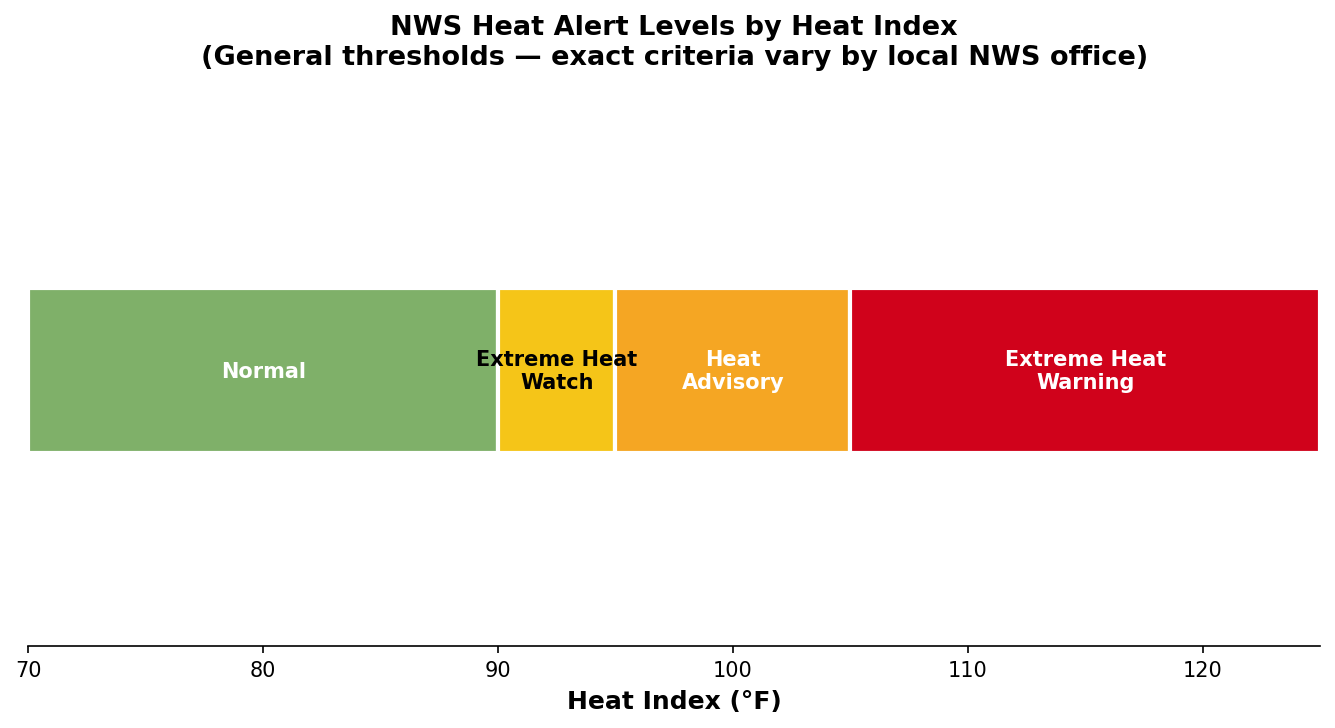
Here’s the detail that trips most people up: there is no single national heat index number that triggers a Heat Advisory or Extreme Heat Warning. Each local NWS forecast office sets its own criteria based on what’s actually dangerous for that specific population and climate.
A few real examples of how much this varies:
- In Boston, a Heat Advisory can be issued at a heat index of just 95°F, because the region and its infrastructure are less acclimated to extreme heat.
- In Miami-Dade and Broward counties, thresholds run meaningfully higher, since residents and infrastructure are more consistently adapted to heat and humidity.
- In parts of South Carolina’s Lowcountry and Midlands, a Heat Advisory triggers around 108°F heat index, while the Upstate/Pee Dee region triggers closer to 105°F.
- Nationally, Extreme Heat Warnings are commonly issued around a 105°F heat index sustained for multiple hours over consecutive days, or a heat index above 115°F for any duration — but local offices can and do adjust these numbers for their specific area.
In short: the label matters more than the raw number. A “Heat Advisory” in one city might represent a higher actual heat index than an “Extreme Heat Warning” in another — because each is calibrated to local risk, not a single national scale.
What to Actually Do at Each Alert Level
During a Heat Advisory
- Limit strenuous outdoor activity, especially between roughly 10 a.m. and 4 p.m.
- Hydrate before you’re thirsty; avoid alcohol and heavily sugared drinks
- Check on elderly relatives or neighbors, especially those without reliable A/C
During an Extreme Heat Warning
- Avoid strenuous outdoor activity entirely where possible
- Stay in air-conditioned spaces as much as you can
- Check on vulnerable neighbors and family members proactively, not just if you happen to hear from them
- Know the difference between heat exhaustion (heavy sweating, weakness, nausea) and heatstroke (hot/dry skin, confusion, no sweating) — the second is a 911 emergency
Check your local, real-time “feels like” number with our Heat Index Calculator rather than relying on the raw air temperature alone — since alert thresholds are based on heat index, not temperature.
Frequently Asked Questions
What’s the difference between a heat advisory and an extreme heat warning?
A Heat Advisory means dangerous heat is expected and you should take precautions; an Extreme Heat Warning means dangerously high heat is happening or imminent and immediate action is needed. The Warning level carries meaningfully higher health risk.
Is “excessive heat warning” the same as “extreme heat warning”?
Yes — the National Weather Service renamed Excessive Heat Watch/Warning to Extreme Heat Watch/Warning in March 2025. Older articles and some regional offices may still reference the previous “excessive heat” terminology, but it refers to the same alert level.
Why did my city issue a heat advisory at a lower temperature than another city?
Heat alert criteria are set locally by each National Weather Service forecast office based on regional acclimatization and infrastructure, not a single nationwide number. Areas less accustomed to extreme heat, like parts of New England, often use lower thresholds than areas where high heat is more routine.
What temperature is considered an extreme heat warning?
Nationally, warnings are commonly issued around a 105°F heat index sustained for multiple hours across two or more consecutive days, or a heat index above 115°F for any duration — though exact criteria vary by local NWS office.
Does a heat watch mean the same thing as an advisory?
No. A watch means conditions are favorable for dangerous heat but timing/severity is still uncertain — it’s a heads-up to prepare. An advisory means dangerous heat is actually expected soon.
Bottom Line
Heat alerts aren’t one-size-fits-all: the label you see reflects your specific region’s risk calibration, not a universal number. Watch means prepare, Advisory means take precautions, and Extreme Heat Warning (the 2025 rename of “Excessive Heat Warning”) means act now. Check your area’s real heat index with our Heat Index Calculator before assuming a forecast temperature alone tells the full story.