In 2023, Phoenix, Arizona experienced 55 consecutive days with a high temperature above 104°F — the longest such streak ever recorded in the city. That same event lasted roughly twice as long as a typical heat wave, driven by record-warm ocean temperatures in both the Atlantic and Pacific working together. Here’s what the actual data shows about how long heat waves last, how that’s changed over the decades, and why duration matters more than peak temperature alone.
Table of Contents
- How Long Does a Heat Wave Have to Last to Count?
- The Actual Average Duration, By the Numbers
- The 60-Year Trend: Heat Waves Are Getting Longer and More Frequent
- The 2023 Southwest Heat Wave: A Case Study in Duration
- Why Duration Matters More Than Peak Temperature
- Frequently Asked Questions
How Long Does a Heat Wave Have to Last to Count?
Definitions vary by organization. The World Meteorological Organization defines a heat wave as five or more consecutive days where the daily maximum temperature exceeds the average maximum by at least 9°F. NOAA’s Heat Wave Index, a commonly cited long-term tracking metric, defines one as a period of at least four consecutive days with average temperatures that would statistically be expected only once every ten years based on historical records — a deliberately conservative bar that captures only genuinely anomalous events.
The Actual Average Duration, By the Numbers
According to EPA and NOAA data tracked via Statista, the average individual heat wave in the U.S. lasted about 4 days in the 2010s — roughly a day longer than the typical heat wave in the 1960s. That might sound like a modest change, but it’s compounded by a much larger shift in how often they occur, not just how long each one lasts.
The 60-Year Trend: Heat Waves Are Getting Longer and More Frequent
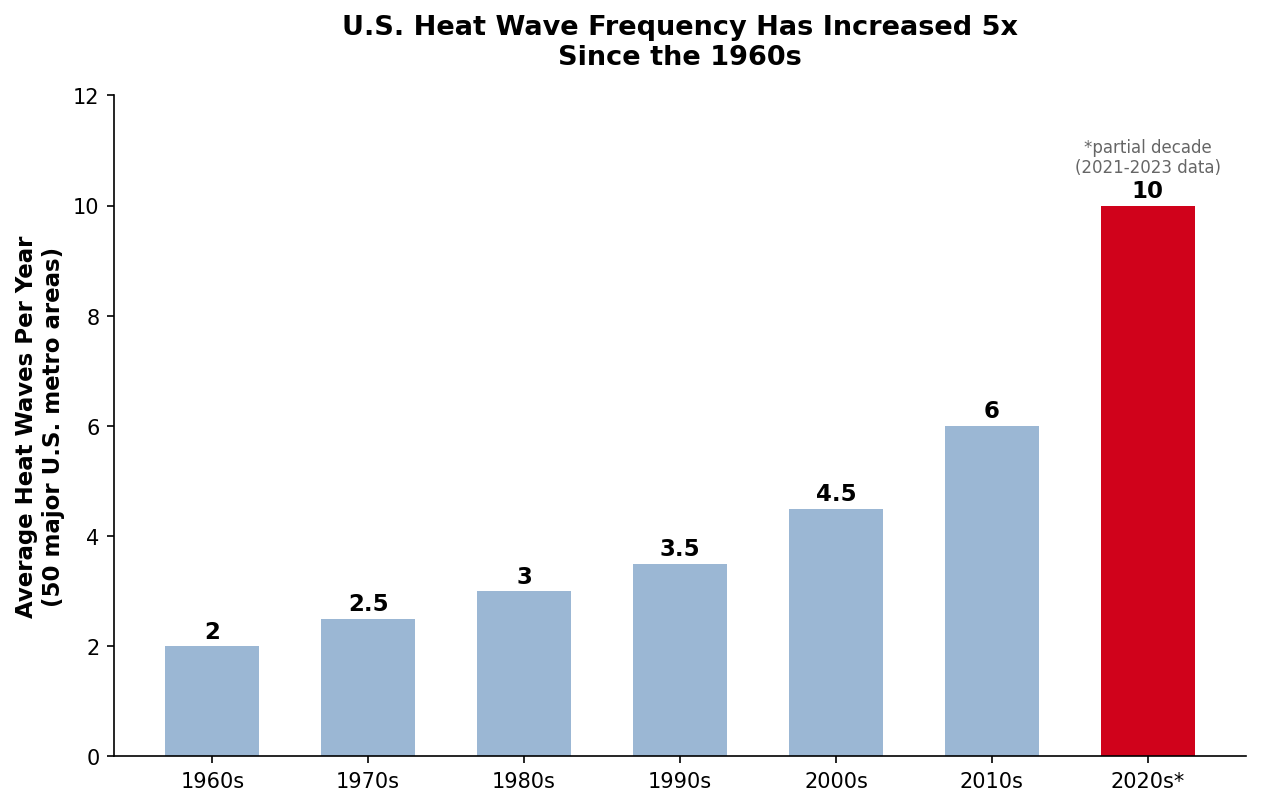
The frequency trend is the more dramatic story. Across 50 major U.S. metropolitan areas, the average number of heat waves per year rose from about 2 per year in the 1960s to roughly 10 per year between 2010 and 2020 — a five-fold increase. Separately, the overall “heat wave season” (the number of days between the first and last heat wave of the year) has lengthened by 46 days since the 1960s, meaning both individual events and the overall window in which they can occur have expanded substantially.
The 2023 Southwest Heat Wave: A Case Study in Duration
The 2023 heat wave that struck the U.S. Southwest and Mexico illustrates what happens when duration compounds with intensity. Beyond Phoenix’s 55-day streak above 104°F, the city also recorded the warmest nighttime minimum temperature ever documented at 97°F — meaning even overnight offered almost no relief. NOAA researchers found this event was driven by an unusual combination of record-warm Atlantic and Pacific sea surface temperatures working together, which roughly doubled the number of regional heat waves that year, tripled their total days, and increased individual event duration by about 50% compared to normal.
The economic and human toll matched the extended duration: the event affected over 100 million people, was linked to more than 300 deaths, and combined with drought to cause $14.5 billion in economic losses — making it the costliest North American weather disaster of that year.
Why Duration Matters More Than Peak Temperature
A single very hot day is uncomfortable but usually survivable for most healthy people. What makes extended heat waves genuinely dangerous is the lack of recovery time:
- The body’s cooling systems get no rest. A single hot day followed by a cool night lets the body recover. Days or weeks of sustained heat, especially with elevated overnight lows, don’t offer that recovery window.
- Infrastructure stress compounds over time. Air conditioning systems, power grids, and water systems that can handle one hot day begin to show real strain after a week or more of continuous high demand.
- Risk accumulates for vulnerable groups. Elderly individuals and those with chronic health conditions face cumulative physiological stress that a single hot day wouldn’t cause on its own.
This is exactly why our Heat Wave Calculator is built to track multi-day trends rather than a single day’s forecast — duration is often the more meaningful risk factor.
Frequently Asked Questions
How many days does it take to officially be a heat wave?
Definitions vary, but common thresholds require at least 3 to 5 consecutive days of abnormally high temperatures. The World Meteorological Organization specifically requires 5+ consecutive days with highs at least 9°F above the local average.
What’s the longest heat wave on record in the U.S.?
Phoenix’s 2023 streak of 55 consecutive days above 104°F stands as one of the most extreme documented examples of sustained extreme heat in a major U.S. city.
Are heat waves getting longer over time?
Yes, though the frequency increase is even more dramatic than the per-event duration increase. Average heat wave duration rose modestly (roughly a day) from the 1960s to the 2010s, while frequency across major U.S. cities increased roughly five-fold over the same period.
Why do overnight temperatures matter for heat wave severity?
Elevated overnight lows prevent the body’s natural recovery period between hot days, which significantly increases cumulative heat stress and health risk compared to heat waves with cooler nights.
Is heat wave season longer than it used to be?
Yes. The average heat wave season across major U.S. metro areas has lengthened by 46 days since the 1960s, meaning the window during which heat waves can occur has expanded substantially, not just their individual frequency or duration.
Bottom Line
Heat wave frequency in major U.S. cities has increased roughly five-fold since the 1960s, and both average duration and the overall heat wave season have lengthened meaningfully. Duration, not just peak temperature, is often what turns an uncomfortable hot spell into a genuinely dangerous event. Track extended heat risk in your area with our Heat Wave Calculator.