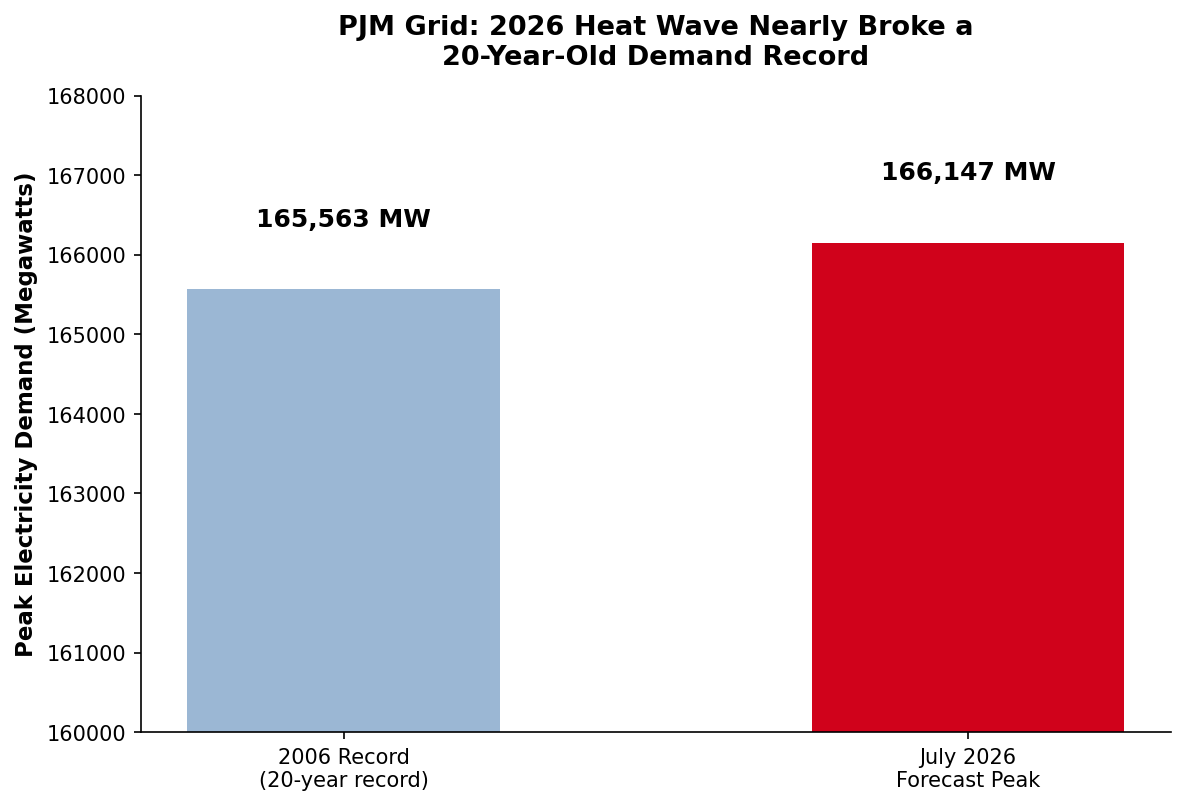
On July 2, 2026, the largest electrical grid in the United States came within 584 megawatts of breaking a record that had stood for 20 years. PJM Interconnection, which supplies power to roughly 65 million people across 13 states and Washington, D.C., forecast peak demand of 166,147 MW that day — just barely below the 165,563 MW record set during the historic 2006 heat wave. Here’s exactly what a “grid emergency” means, why heat waves cause them, and what actually happens to your power during one.
Table of Contents
- What Happened: The July 2026 PJM Emergency
- Why Heat Waves Strain the Power Grid
- What a DOE Emergency Order Actually Does
- Grid Alert Levels, Explained
- What This Means for Your Power and Your Bill
- Frequently Asked Questions
What Happened: The July 2026 PJM Emergency
As a dangerous heat dome settled over the central and eastern U.S. ahead of the July 4th holiday, U.S. Secretary of Energy Chris Wright issued an Energy Emergency Alert under Section 202(c) of the Federal Power Act, directing PJM Interconnection to take emergency action to prevent blackouts. The order ran from Tuesday night through Friday, directing PJM to curtail power to data centers and other large, non-emergency electricity users with backup generators.
The 14 PJM states most at risk spanned Delaware, Illinois, Indiana, Kentucky, Maryland, Michigan, New Jersey, North Carolina, Ohio, Pennsylvania, Tennessee, Virginia, West Virginia, and Washington, D.C. During the peak, more than 200,000 customers lost power as demand surged and equipment, including transformers, overheated in the extreme conditions.
Why Heat Waves Strain the Power Grid
Several factors compound during a major heat event to push grids toward their limits:
- Air conditioning demand spikes simultaneously across a huge area. Unlike a normal hot day affecting one region, a heat dome can push extreme demand across two-thirds of the country at once, leaving no nearby grid with spare capacity to help.
- Overnight lows stay dangerously high. Grid operators normally take power plants offline for routine maintenance overnight when demand drops. During a heat dome, nighttime temperatures often don’t drop enough to allow this, keeping the system under continuous strain.
- Transmission capacity actually decreases in extreme heat. Power lines carry less electricity efficiently as temperatures rise, meaning the grid’s effective capacity shrinks at exactly the moment demand is highest.
- Equipment failures increase. Transformers and other grid equipment are more prone to overheating and failing during sustained extreme heat, causing localized outages independent of any grid-wide emergency.
What a DOE Emergency Order Actually Does
A Section 202(c) order is a specific legal tool that gives the Secretary of Energy authority to direct emergency measures during electric reliability crises. In practice, during the July 2026 event, it directed PJM to:
- Curtail power to data centers and other large consumers that have backup generators available
- Defer non-essential maintenance and testing on generation and transmission equipment
- Bring all available generating capacity online, including units normally held in reserve
- Increase voltage across critical transmission interfaces to improve power transfer capability
Importantly, this is different from an actual blackout — it’s a set of proactive measures specifically intended to prevent one.
Grid Alert Levels, Explained
| Alert | What It Means |
|---|---|
| Hot Weather Alert | Advance notice that extreme heat may stress the grid; no action required from consumers yet |
| Conserve Energy Alert | Voluntary request to reduce electricity use, especially during peak hours (typically 4–9 p.m.) |
| Maximum Generation Alert | Directs power plant operators to defer maintenance and bring all available generation online |
| Load Management Alert | Advance notice that demand response programs may be activated to reduce strain |
| Low Voltage Alert | Operational step to increase transmission capacity across the system |
| Rolling Blackouts (last resort) | Localized, temporary, rotating power interruptions used only if all other measures fail to prevent a wider system failure |
What This Means for Your Power and Your Bill
A grid emergency doesn’t automatically mean you’ll lose power — the entire point of these measures is to prevent that. But there are real, practical effects worth knowing about:
- Wholesale electricity prices can spike sharply. During the July 2026 event, wholesale spot prices jumped more than 243% in New England and 101% in New York City. Customers on variable-rate plans may see this reflected in their bills; fixed-rate plans are unaffected by these short-term swings.
- Utilities may ask you to voluntarily conserve energy, especially avoiding major appliances (washers, dryers, EV chargers) during peak afternoon-to-evening hours.
- Many states now protect against disconnection during heat emergencies. New York’s Public Service Commission, for example, approved a policy in March 2026 prohibiting utilities from terminating service for non-payment during extreme heat events — check whether your state has a similar protection if you’re worried about a bill.
- Localized outages can still happen from equipment failures even without a grid-wide emergency, particularly affecting older infrastructure.
Check your local heat risk with our Heat Index Calculator or track an extended event with our Heat Wave Calculator so you know when grid stress — and the conservation requests that come with it — are most likely.
Frequently Asked Questions
What is a PJM grid emergency?
It’s a set of emergency operational measures, sometimes backed by a federal Department of Energy order, used to prevent blackouts when extreme demand (often from heat waves) threatens to overwhelm the electrical grid’s capacity.
Will my power definitely go out during a grid emergency?
Not necessarily. Grid emergencies are specifically declared to prevent widespread outages through measures like conservation requests and bringing reserve power online. Rolling blackouts are a last resort used only if those measures aren’t enough.
Why did my utility ask me to conserve energy?
Extreme heat drives sharp increases in electricity use, mainly from air conditioning, straining the grid’s capacity. A conservation request (sometimes called a “Conserve Alert”) asks customers to voluntarily reduce usage during peak hours to help prevent the need for more serious measures.
Can my utility shut off my power for non-payment during a heat wave?
It depends on your state. Some states, including New York as of March 2026, prohibit disconnections during declared extreme heat events. Contact your utility directly if you’re at risk of disconnection during a heat emergency.
Why do data centers get targeted first during grid emergencies?
Large data centers and similar facilities are often required to have backup generators as part of their own reliability planning, making them one of the first places grid operators can redirect demand from without affecting homes, hospitals, or other essential services.
Bottom Line
The July 2026 heat wave pushed America’s largest electrical grid to within a fraction of a percent of a 20-year-old demand record, triggering a federal emergency order and real financial impacts through spiking wholesale prices. Grid emergencies are designed to prevent blackouts, not cause them — but conservation requests during peak hours are a real, useful signal that a major heat event is straining the system. Check your local conditions with our Heat Index Calculator before a heat wave hits.