Hurricanes and floods leave rubble you can point a camera at. Heat waves don’t — but according to research from the Atlantic Council and consultancy Vivid Economics, extreme heat is already draining roughly $100 billion a year from the U.S. economy, a figure with no dramatic wreckage to show for it. Here’s where that number actually comes from, how it’s projected to grow, and which parts of the country and economy bear the biggest burden.
Table of Contents
- The Headline Numbers
- Where the Losses Actually Come From
- Which States Lose the Most
- Who’s Affected Most
- The Global Picture
- What Businesses and Households Can Do
- Frequently Asked Questions
The Headline Numbers
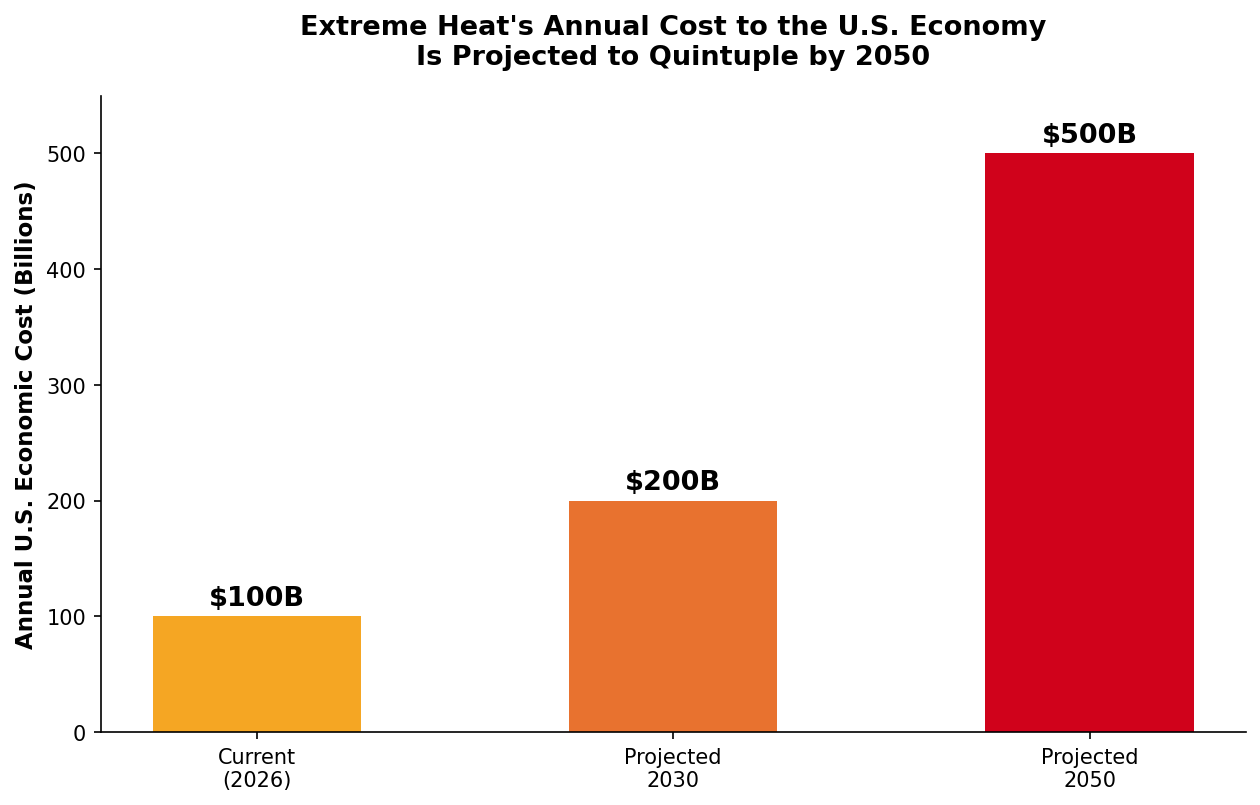
According to a Vivid Economics analysis for the Atlantic Council, extreme heat currently costs the U.S. economy about $100 billion annually in lost labor productivity alone — and that figure is deliberately conservative, excluding harder-to-measure impacts like tourism, wildfire costs, and mechanical equipment failures. That cost is projected to climb toward $200 billion by 2030 and roughly $500 billion annually by 2050 as extreme heat days become more frequent.
Where the Losses Actually Come From
Unlike a hurricane’s visible destruction, heat’s economic toll accumulates through several less obvious channels:
- Outdoor worker productivity loss. Construction, agriculture, and landscaping workers must slow down or take mandatory rest breaks in extreme heat, directly reducing output per hour worked.
- Indoor productivity loss too. Warehouses, manufacturing facilities, commercial kitchens, and transit systems without adequate cooling also see measurable efficiency declines during sustained heat, not just outdoor work.
- Agricultural losses. A global study covering 1961–2014 found combined heat and drought disasters cost the U.S. specifically an estimated $116 billion in crop production losses over that period — the largest national loss of any country studied.
- Grid and infrastructure strain. Emergency power measures, equipment failures, and increased wholesale electricity prices during heat waves add real, if less visible, costs across the economy.
Which States Lose the Most
The economic burden isn’t distributed evenly. Texas — due to its climate and comparatively high share of outdoor work — is currently losing an estimated $30 billion a year, the report found, with that figure projected to reach roughly $110 billion a year by 2050, equivalent to about 2.5% of the state’s total economic output. More broadly, the Southeast and Midwest face the highest projected economic costs from extreme heat nationally, and more than 60% of U.S. counties are already losing a significant share of their local economies to heat-related productivity stress.
Who’s Affected Most
The impact of heat on work isn’t distributed equally across the population. Research cited by Atlantic Council/Vivid Economics found that Black and Hispanic workers disproportionately live in more heat-exposed regions and often face jobs with less protection from heat exposure, resulting in measurably higher productivity-related income losses compared to the general workforce.
The Global Picture
Zooming out, a 2022 Dartmouth College study estimated that economic damage from human-caused extreme heat totaled as much as $50 trillion worldwide over a recent 30-year period. Researchers involved describe lost productivity from heat as one of the fastest-growing economic costs of climate change specifically, distinct from more visible disaster costs like storm or flood damage.
What Businesses and Households Can Actually Do
While the macro-level numbers are largely outside any individual’s control, both employers and households have real, practical levers available:
- For employers in heat-exposed industries: shifting outdoor work to early morning hours, building in acclimatization periods for new workers, and investing in shade and hydration infrastructure aren’t just safety measures — they measurably reduce the productivity losses driving these economic figures in the first place.
- For agricultural operations: heat-resistant crop varieties and adjusted planting schedules can reduce exposure to the most damaging heat windows, though this requires longer-term planning rather than reactive adjustment.
- For households: monitoring real heat index conditions rather than relying on air temperature alone helps you make better decisions about outdoor activity, work scheduling, and energy use during peak-cost hours, which can meaningfully reduce personal financial exposure to heat-driven utility price spikes.
- For local governments: cooling centers, updated building codes, and heat action plans are increasingly cited by economists as some of the highest-return investments available for reducing heat’s cumulative economic toll on a community.
None of these measures eliminate the underlying cost of a warming climate, but research consistently shows that preparedness and adaptation measurably reduce the economic impact of individual heat events, even without addressing the root climate trend itself.
Frequently Asked Questions
How much does extreme heat cost the U.S. economy per year?
Current estimates put annual U.S. losses from heat-related productivity impacts at roughly $100 billion, a figure that excludes harder-to-quantify costs like tourism impacts and wildfire damage, meaning the true total is likely higher.
Which state loses the most money to heat waves?
Texas currently loses an estimated $30 billion annually due to its climate and high share of outdoor labor, with that figure projected to grow to roughly $110 billion a year by 2050 according to Atlantic Council-commissioned research.
Does heat affect indoor workers economically too?
Yes. Warehouses, manufacturing facilities, and commercial kitchens without adequate cooling see measurable productivity declines during sustained heat events, not just outdoor industries like construction and agriculture.
How much could heat cost the economy by 2050?
Projections from the same Atlantic Council/Vivid Economics analysis put annual U.S. heat-related economic losses at approximately $500 billion by 2050, roughly five times the current estimated cost.
Is the economic impact of heat waves distributed equally across workers?
No. Research indicates Black and Hispanic workers are disproportionately concentrated in more heat-exposed regions and jobs with less heat protection, resulting in measurably higher relative economic impact from heat-related productivity loss.
Bottom Line
Extreme heat’s roughly $100 billion annual cost to the U.S. economy rivals or exceeds the visible damage from many individual natural disasters — it’s simply less photogenic, accumulating through lost productivity rather than physical destruction. With costs projected to climb toward $500 billion annually by 2050, tracking and preparing for extended heat events matters economically, not just for personal safety. Check current and forecasted conditions with our Heat Wave Calculator.