When a major winter storm hit the Northeast in late January 2026, New York City didn’t call a traditional snow day. Instead, roughly 500,000 of the district’s nearly 900,000 students logged into remote classes while school buildings stayed closed. It’s part of a bigger shift playing out unevenly across the country: the classic “no school, no work, just snow” day is slowly being replaced in some districts — but far from all of them.
Table of Contents
- Why Some Districts Are Moving to Remote Learning Days
- How State Policy Varies (It’s a Patchwork)
- Does Remote Learning on Snow Days Actually Work?
- Who’s Still Using Traditional Snow Days, and Why
- Snow Day vs. Remote Learning Day: Key Differences
- Frequently Asked Questions
Why Some Districts Are Moving to Remote Learning Days
The shift traces directly back to COVID-19, which forced every district in the country to rapidly build out remote learning infrastructure almost overnight. Once that capability existed, an obvious question followed: if kids can learn from home during a pandemic, why not during a snowstorm too?
The core driver is almost always the same: state-mandated minimum instructional days. Traditional snow days typically have to be made up later in the year, cutting into breaks or extending the school year. Remote learning days, where permitted, usually count as a full instructional day without requiring makeup — which is a meaningful incentive for administrators managing a tight calendar.
How State Policy Varies (It’s a Patchwork)
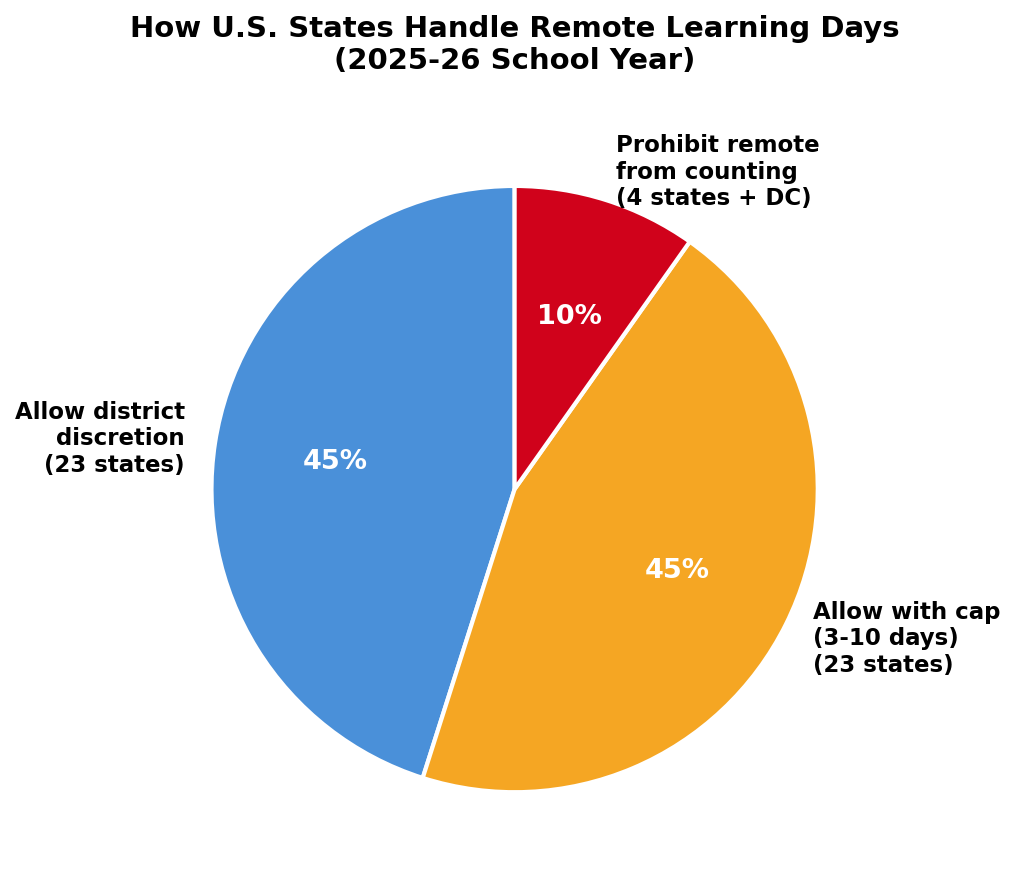
There’s no national standard here at all — it’s decided state by state, and often district by district within a state. As of the 2025–2026 school year:
- 4 states plus Washington, D.C. prohibit remote learning from counting toward required instructional time at all, meaning traditional snow days (with later makeup) remain the only option.
- 23 states allow remote learning days but cap how many can count toward the year, typically 3–5 days, though a handful of states (including Virginia and Kentucky) allow up to 10.
- 23 states leave the decision almost entirely to individual district discretion, with no firm statewide cap.
Some states actively encourage the remote option as a way to preserve “educational continuity,” while others remain openly skeptical of its value, particularly for younger students.
Does Remote Learning on Snow Days Actually Work?
The honest answer: it’s mixed, and there isn’t strong dedicated research yet specifically on remote snow days. What we do know:
- Attendance drops meaningfully. In one Pittsburgh-area analysis, attendance on virtual snow days ranged all the way from 99% down to as low as 66% depending on the school.
- Younger students struggle more. Elementary-age children, especially those without prior remote learning experience, have shown more difficulty engaging meaningfully compared to middle and high schoolers who already use school-issued devices regularly.
- Equity gaps are a real concern. Students without reliable home internet, a quiet workspace, or a stable home environment are disproportionately left behind on remote days — a concern cited by superintendents in more rural and lower-income districts as a reason to stick with traditional snow days.
- Research on snow days themselves is genuinely mixed. A study of Massachusetts students found that snow days themselves didn’t meaningfully hurt test scores, while a separate study of Maryland students found a negative association between snow days and scores — the research base isn’t settled enough to say confidently that remote days are clearly “better” for learning outcomes.
Who’s Still Using Traditional Snow Days, and Why
Plenty of districts have deliberately stuck with the classic model, or reversed course after trying remote days:
- Some rural districts cite unreliable internet access and device availability as reasons remote learning simply isn’t equitable for their student population.
- Some state laws block it outright — for example, remote instruction may only be permitted to count toward required school days under specific emergency declarations, not routine weather closures.
- Some districts tried it and rolled it back after early technical failures (login system crashes, unprepared staff) undermined confidence in the approach.
- Some districts require state approval for a virtual learning plan before they’re even allowed to convert weather closures into remote days, and simply haven’t obtained that approval yet.
Snow Day vs. Remote Learning Day: Key Differences
| Factor | Traditional Snow Day | Remote Learning Day |
|---|---|---|
| Counts toward instructional days? | No — must be made up later in most states | Often yes, where state policy allows it |
| Requires device/internet access? | No | Yes — a real equity concern for some families |
| Typical attendance | N/A (school is simply closed) | Highly variable — from near-full to well below two-thirds in some schools |
| Best suited for | Younger students, districts with equity/access concerns | Older students with reliable devices and structured remote routines |
| Legal in every state? | Yes, universally available | No — several states restrict or prohibit it from counting toward instructional time |
Frequently Asked Questions
Are snow days being phased out?
Not universally. Some large districts, particularly in the Northeast, have shifted toward remote learning days, but a substantial number of districts nationwide continue to use traditional snow days, either by choice, state law, or lack of remote learning infrastructure.
Does remote learning count as a school day during a snowstorm?
It depends entirely on your state. Some states allow it to count toward required instructional time (with restrictions on how many days), some prohibit it entirely, and some leave the decision up to individual districts.
Why did New York City stop having traditional snow days?
NYC shifted toward remote learning during weather closures starting in 2020, largely driven by a tight instructional calendar with limited room for makeup days, given the number of required school days and holidays already built into the schedule.
Is remote learning as effective as in-person school during a snow day?
The evidence is mixed. Attendance and engagement on remote snow days vary widely by school and grade level, and dedicated research specifically on remote snow days (as opposed to remote learning generally) is still limited.
Why do some districts refuse to use remote learning for snow days?
Common reasons include unreliable internet or device access for some students, state laws that don’t permit it to count toward instructional time, lack of state-approved virtual learning plans, or past technical failures that undermined confidence in the approach.
Bottom Line
Whether your district calls a traditional snow day or shifts to remote learning depends heavily on your state’s policy and your district’s specific calendar pressures — there’s no national standard, and the research on which approach is genuinely better for students is still far from settled. Either way, check your real-time closure odds with our Snow Day Calculator before a storm hits, then confirm the specific plan (closed, remote, or delayed) through your official school district channels.